
![Professor Herb Premium Hemp Blend (24g) - Citrus Cookies [LIMITED EDITION]](https://professorherb.co.uk/wp-content/uploads/2026/08/0005__1-18-600x600.jpg)
![Professor Herb Premium Hemp Blend (24g) - Citrus Cookies [LIMITED EDITION] (3 Pack)](https://professorherb.co.uk/wp-content/uploads/2026/08/0003__1-51-600x600.jpg)
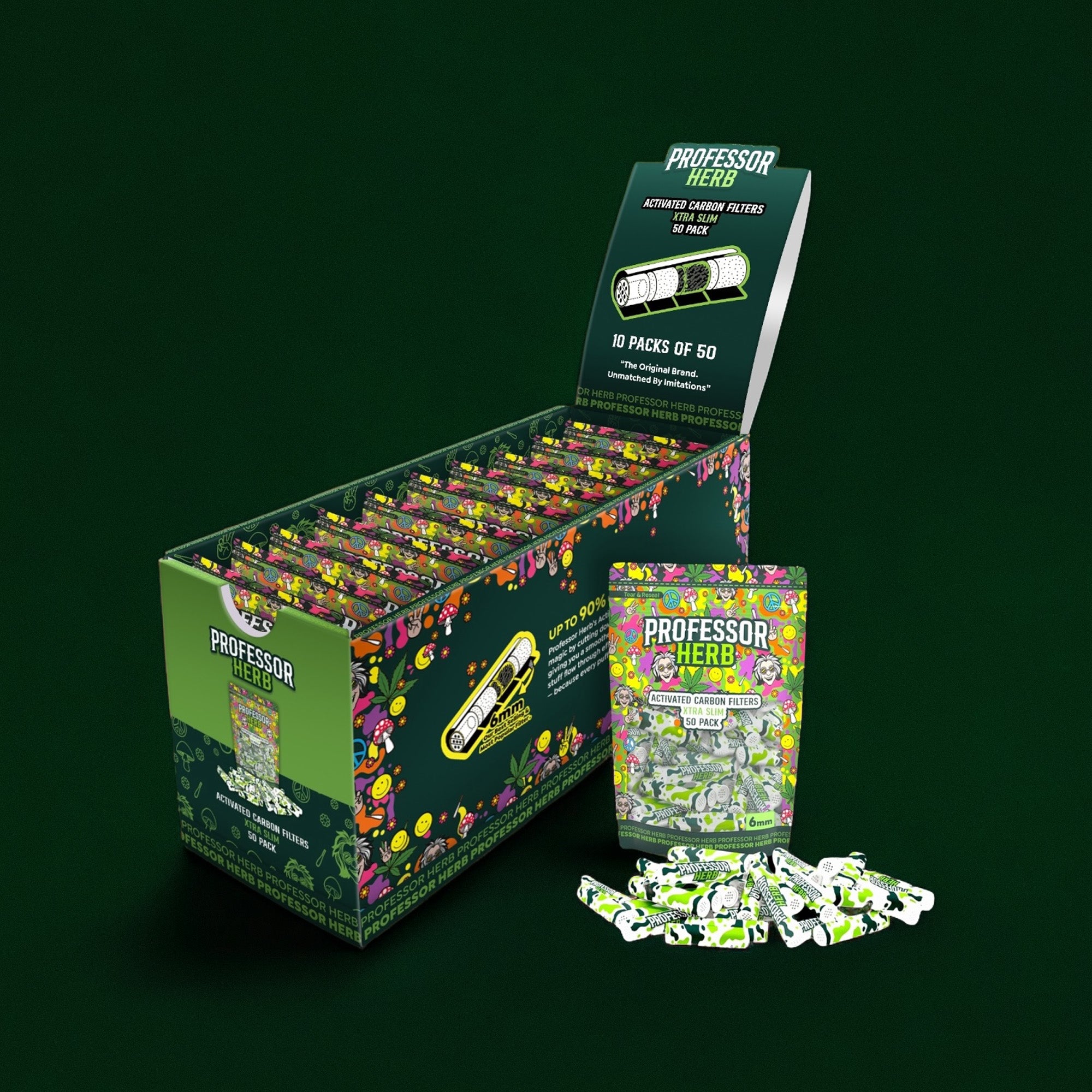
Activated carbon filters (also called activated carbon tips or charcoal filters) are small filter tips filled with porous activated carbon. You roll them into a joint in place of a cardboard tip, or drop them into some pipes and mouthpieces, so the smoke passes through the carbon before it reaches your mouth.
They are not the same as a normal paper roach. A cardboard tip mainly holds the joint together and stops bits of herb going in your mouth. An activated carbon filter is designed to do that as well, while the carbon inside is intended to trap some of the harsh, tarry, and odorous compounds in the smoke.
That is why so many people search for activated carbon filters for joints, activated carbon tips, and charcoal filters for smoking. Many users say the draw feels cooler, smoother, and less scratchy.
Important: Professor Herb does not make any health, medical, or harm-reduction claims about activated carbon filters. The information below is general background on how these products are commonly described by manufacturers, researchers, and users. Smoking remains harmful. These tips do not make smoking safe.
What is activated carbon?
Activated carbon is charcoal that has been treated with heat and steam so it becomes extremely porous. It is often said that one gram can have an internal surface area of around 500 to 1,500 square metres, roughly the size of a tennis court packed into a few millimetres of filter.
The process commonly described is adsorption (not absorption). Molecules can stick to the carbon’s inner surface, rather than soaking into it like water in a sponge.
Professor Herb tips use activated carbon with ceramic caps at each end. The caps are there to help keep the granules in place and to stand up to heat during a session. You can find them here!
How do activated carbon filters work? 🤔
The usual description of a draw is:
- Smoke travels from the burning end towards the mouthpiece.
- It passes through the carbon granules.
- Some tar, volatile organic compounds, and other combustion by-products can stick to the carbon.
- Many users then notice cooler or milder smoke.
A slower, steadier draw is often recommended, because the smoke spends more time in contact with the carbon.
They are commonly used in:
- Hand-rolled joints and spliffs (instead of a cardboard tip)
- Pre-rolls that come with carbon tips already fitted
- Some pipes, one-hitters and bong mouthpieces
- A smaller number of vaporizer accessories
Popular everyday sizes are 6 mm (slim / extra slim) for standard joints and 7 to 8 mm for thicker rolls, blunts, or pipes. Professor Herb Activated Carbon Filters are extra slim at 6 mm, with ceramic caps, and are packed for everyday self-rolling.
Professor Herb is not claiming that any particular size will filter a set amount of anything. Size is mainly about fit and airflow.
What are they said to filter, and what are they not? 💨
The points below are how these products are generally discussed. They are not claims made by Professor Herb.
They are often described as reducing:
- Tar and resin-like condensate
- Some volatile organic compounds (VOCs)
- Irritating gases such as benzene, acrolein and formaldehyde
- Harsh, bitter or ashy flavours
- Some of the smell that lingers on fingers and breath
- Loose plant crumbs
They are generally not said to reliably remove:
- Carbon monoxide
- Nicotine (if you are smoking tobacco)
- Every carcinogen in smoke
- All harshness on every draw
Even where reductions are discussed in research on charcoal cigarette filters, the effect is partial. These tips may make smoke feel milder for some people. However, they do not make smoking safe, and Professor Herb does not claim that they do.
Flavour is also a matter of opinion. Some people find the taste cleaner. Others say some terpenes (the compounds that give herb its smell) can be reduced, so the flavour feels a little softer. Cannabinoids such as THC and CBD are often described as passing through more easily than heavier tar particles, which is why many users still feel the effects. Professor Herb does not claim that carbon tips preserve or remove potency.
Activated carbon tips vs paper tips vs glass tips
| Feature | Paper / cardboard tip | Activated carbon filter | Glass tip |
|---|---|---|---|
| Stops crumbs | Yes | Yes | Yes |
| Often described as filtering tar / gases | Almost none | Yes (adsorption) | Almost none |
| Cooler, smoother draw | Slight | Many users notice this | Cooler airflow, no carbon layer |
| Flavour | Neutral | Often described as milder | Very clean |
| Reusable | No | No (single use once saturated) | Yes |
| Best for | Basic rolling | People who want a different draw | Flavour and reuse |
If you only want structure, paper is enough. If you want a different, often cooler draw, activated carbon is the option many people try next.
How to use Professor Herb activated carbon tips 👩🏫
- Put the filter at the mouthpiece end of the paper, the same way you would place a cardboard tip.
- Roll the paper tightly around it so air cannot sneak past the sides. All the smoke should go through the carbon.
- Do not crush the filter. Squeezing it can block the airflow.
- Draw a bit slower than usual.
- Change it when the pull gets tight, the taste turns stale or musty, or the inside looks dark and wet.
Follow the pack if one ceramic end is marked as the burn-side cap. That end should face the burning herb so the cap is not in your mouth.
Most joint tips are one session, maybe two. Once the pores are full, the filter is generally considered spent. You cannot wash activated carbon back to new.
Store unused Professor Herb filters somewhere dry. Damp carbon can clog faster.
Shop Here For Our Own Activated Carbon Filters 👈
Pros and cons (based on common user feedback)
Often reported as positives ✅
- Smoother, cooler smoke
- Less throat scratch and coughing for some people
- Cleaner taste with fewer bitter combustion notes
- Stops loose herb reaching your mouth
- Easy swap from a normal cardboard tip
Often reported as downsides ❌
- Does not remove all harmful substances
- Can slightly soften flavour
- Single use. You need a fresh one regularly
- Can clog if the herb is very moist or you pack too tight
- Costs more than a strip of cardboard
These are observations people share. They are not promises from Professor Herb.
Frequently asked questions 🤨
➡️ Do activated carbon filters remove THC?
Professor Herb does not claim that they do or do not. Heavier tar and many gases are often described as more likely to stick to the carbon than cannabinoids. Many users still feel the effects.
➡️ Are they healthier?
Professor Herb does not make this claim. Some people use them because the smoke feels less irritating. Smoking is still smoking. Treat them as a smoking accessory, not a health product.
➡️ What size are Professor Herb filters?
Professor Herb extra-slim activated carbon filters are 6 mm, which is the everyday size for standard joints and most rolling papers. You can find them here!
➡️ Can I reuse them?
Not once they are saturated. A used filter that tastes stale or pulls hard should go in the bin.
➡️ Which way round do they go?
Follow the pack. If there is a ceramic cap designed for the burning end, that cap should face the herb so it does not scorch. If both ends look the same, either way is usually fine as long as the paper seals around it.
➡️ Do they work in pipes as well as joints?
6 mm extra-slim tips are made first for joints. Wider 7 to 8 mm carbon filters are more common for pipes and larger mouthpieces.
Are activated carbon filters worth it? 🤷♀️
That depends on what you want from a session. If you roll regularly and you dislike harsh, hot, scratchy smoke, many people prefer carbon tips for comfort and a cleaner-feeling draw.
They are a small rolling upgrade, more like choosing different papers than buying a medical device. Professor Herb does not claim they protect your health.
Professor Herb Activated Carbon Filters come in extra-slim 6 mm packs with ceramic caps, ready to roll in place of a cardboard tip. If you want to try a different style of tip, swap the cardboard for carbon and see how it feels on the next roll. You can find them here! 👈